European Standards
Committee for Electro Technical Standardisation (CENELEC)
CENELEC is the European Committee for Electro technical Standardisation and is responsible for standardisation in the electro technical engineering field. CENELEC prepares voluntary standards, which help facilitate trade between countries, create new markets, cut compliance costs and support the development of a Single European Market. Equipment manufactured to a CENELEC standard will bear the CE mark shown here.
In 2006, IEC 60079 introduced Equipment Protection Levels (or EPLs). These mirror the Equipment Categories used by ATEX. For Group II equipment, three categories of equipment are considered. Although there are several clauses covering the requirement of each category they are primarily concerned with the probability of an ignition source being present.
Category 1 / EPL Ga Equipment Equipment manufactured to this construction level ensures a very high level of protection. Equipment in this category is intended to be used where flammable mixtures are continuously present, e.g. Zone 0. Protection is assured in the event of two independent faults has use of an independent second means of protection
Category 2 / EPL Gb Equipment Equipment manufactured to this construction level ensures a high level of protection. Equipment in this category is intended to be used where flammable mixtures are likely to be present, e.g. Zone 1. Protection is assured even in the event of disturbances or equipment faults
Category 3 / EPL Gc Equipment Equipment manufactured to this construction level ensures a normal level of protection. Equipment in this category is intended to be used where flammable mixtures are not likely to be present but if they do then this will only be for a short period, e.g. Zone 2. Protection is assured in normal operation
The three categories of equipment stated in the ATEX Equipment Directive normally (unless a risk assessment states otherwise) equates to types of equipment which may be used in Zones 0, 1 and 2 for gases.

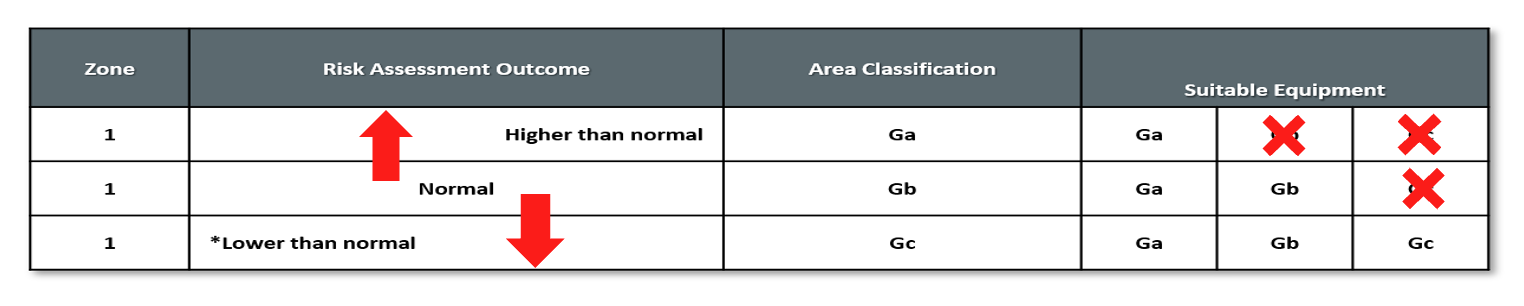
However, if a risk assessment is carried out to take into account the consequences of ignition, it may be concluded that in a particular Zone 1 area, equipment Category 1 is required as the consequences are higher than normal.
Conversely, it may be determined that in a different Zone 1 area, equipment to category 3 may be permitted.
It is intended that in future area classification drawings that not only zones are specified but also the required category/ equipment protection levels.